

Two dishwashers sit side by side on the showroom floor, both stainless, both twenty-four inches, both with the controls hidden along the top edge of the door. The spec cards share most of the same words, the badges are different, and there is a several hundred dollar gap that nobody has explained. Meanwhile the machine at home still leaves grit on the bottom rack after every cycle and every glass has to be towel-dried before it goes in the cabinet. That is the exact moment most people start searching for a GE Cafe dishwasher comparison and come away more confused than they started.
See Both GE Dishwasher Lines Side by Side Before You Buy
East Coast Appliance sells and services the full GE Appliances family, including Cafe and GE Profile, across Hampton Roads and the Richmond area. Our showroom staff will show you the hardware finishes in person, and our own crews handle delivery, professional installation, and factory-authorized service.
The distinction is clearer than the spec sheets make it look, and it comes down to a handful of decisions rather than a wall of features. At East Coast Appliance, our team sells and services both lines every week for customers from Virginia Beach and Williamsburg to Midlothian and Short Pump, so we know where the money actually goes and where it does not. This guide covers where each brand sits in the GE Appliances family, the design and hardware differences, wash and dry performance, noise and everyday livability, smart features, a full side-by-side comparison, honest trade-offs, and which line fits which kind of buyer.
Key Takeaways
Same manufacturer, same service network: Cafe and GE Profile are both GE Appliances brands built with shared engineering and covered by the same factory-authorized service, so the choice is not about reliability pedigree.
- Cafe sells design, Profile sells performance per dollar: The customizable hardware program is the flagship Cafe differentiator, while Profile concentrates the budget on wash, dry, and quiet operation.
- Drying technology matters more than wash claims: Condensation-only drying is the reason plastic containers come out wet, and fan-assisted drying with an auto door open is the upgrade that actually fixes it.
- Compare models, not badges: Series and model year change the feature set significantly within each line, so two dishwashers wearing the same brand can be very different machines.
Where Cafe and Profile Fit in the GE Appliances Family
GE Appliances sells under several brands, and understanding the ladder settles most of the confusion immediately. From entry to flagship, the order runs Hotpoint, GE, GE Profile, Cafe, and Monogram at the top.
GE Profile sits in the mid-to-upper tier. It is built around clean contemporary design and strong day-to-day performance, and it is where most of the meaningful feature upgrades over a base GE model first appear. Cafe sits above it as the premium design-forward tier, built around customization and a professional-inspired look, aimed at kitchens where the appliances are part of the design plan rather than a purchase to be gotten over with.
Here is the fact that answers most of the searches: both lines are made by the same manufacturer, share engineering and components, and are serviced through the same authorized network. A Cafe dishwasher is not built in a different factory by a different company. Moving up the ladder buys you materials, hardware finish choices, feature depth, wash system refinement, and quieter engineering, not a different standard of reliability.
One caution before you compare anything. Series and model year matter more than the badge. A high-series GE Profile dishwasher can carry a longer feature list than a base Cafe model, so compare the specific machines you are considering rather than arguing about brand names.
Design, Finishes, and Customizable Hardware
Design is where these two lines genuinely part ways, and it is the honest reason most Cafe buyers choose Cafe.
Two Different Visual Languages
GE Profile leans sleek and minimal. Integrated handles, streamlined controls, and a flat contemporary face that recedes into a run of cabinetry. It is designed not to draw attention, which is exactly right for many kitchens.
Cafe leans professional and deliberate. Straight bar handles, heavier hardware, and proportions borrowed from commercial equipment. A Cafe dishwasher announces itself as part of a designed kitchen, which is the point.
The Customizable Hardware Program
This is the flagship differentiator for a GE Cafe dishwasher and it has no equivalent in the Profile line. Cafe appliances accept swappable handle kits in finishes including brushed brass, brushed bronze, brushed copper, brushed black, and brushed stainless. The hardware attaches to the appliance, not to the factory, which means a homeowner can change the look years later for the cost of a hardware kit instead of the cost of a new dishwasher.
That matters more than it sounds. Kitchen hardware trends move faster than appliances wear out, and this is the one program that lets an appliance follow a repaint or a new faucet.
Read more:
Built-In Dishwasher Buying Guide: Features That Matter Most
GE Profile Dishwashers Reviewed
Finishes, Panels, and Controls
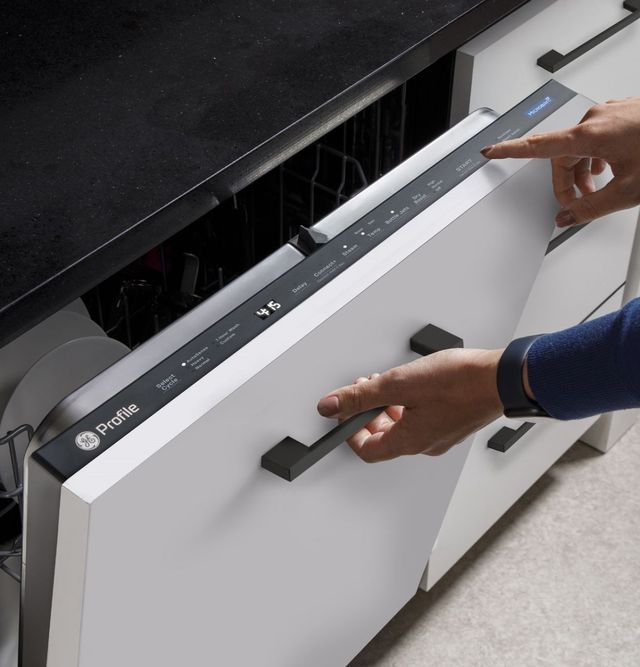
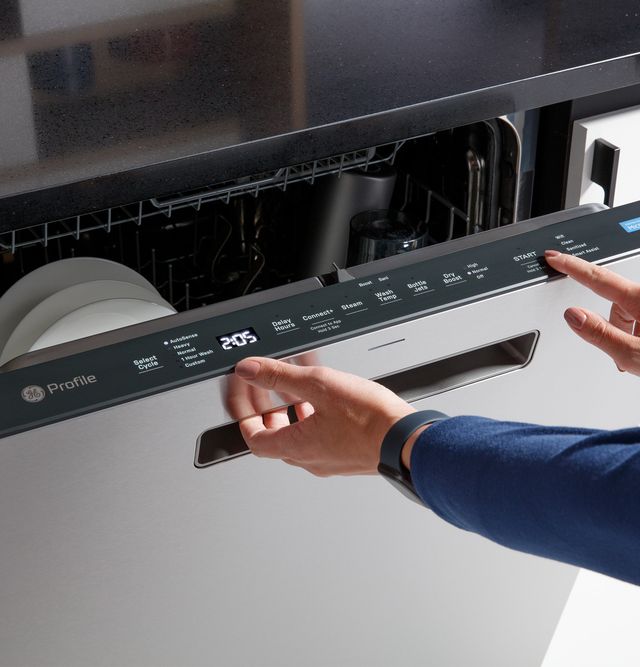
Both lines offer stainless, and both offer panel-ready configurations that accept a cabinet front for full integration. Matte white and matte black options widen the palette on the design-focused models. Control placement is worth thinking about: top control models hide the panel along the upper edge of the door for an uninterrupted front, while front control models keep the buttons visible and reachable without opening the door. In a long run of cabinetry, hidden controls are what make the dishwasher disappear.
Judging Finish in Context
Do not choose a finish in isolation. Hold the handle option against your cabinet hardware, your faucet, and your lighting fixtures at the same time, because brushed brass next to polished chrome reads as a mistake rather than a mix. The same suite logic applies to the range and refrigerator: a dishwasher that matches the rest of the kitchen is worth more visually than a nicer dishwasher that does not.
Wash Performance, Racking, and Cleaning Technology
Wash performance is where the marketing gets thickest, so it helps to know what the terms actually describe.
Spray Arms and Cleaning Jets
The wash system is a matter of coverage. More jets, better placement, and multi-blade or reversible wash arms all serve the same goal of putting water on every surface of every dish. Targeted zone washing on the upper rack directs higher pressure at bottles, travel mugs, and narrow containers, which are the items that come out with water still trapped inside.
Filtration, Honestly
Older dishwashers used a hard food disposer, a small grinder that chopped debris. Nearly all current machines, including both of these lines, use a filtration system instead. Filtration is quieter and more efficient, and it changes your habits in one specific way: you scrape plates, but you do not need to pre-rinse them, and you do need to clean the filter periodically.
Here is the maintenance detail our service technicians run into more than any other. When someone calls because there is grit on the bottom rack after every cycle, the cause is almost always a clogged cylindrical filter under the lower spray arm, not a failing pump. Twist it out, rinse it under the tap with a soft brush once a month, and the complaint disappears. It takes ninety seconds, and skipping it is the single most common reason a good dishwasher seems to get worse over its first two years.
Racking in Practical Terms
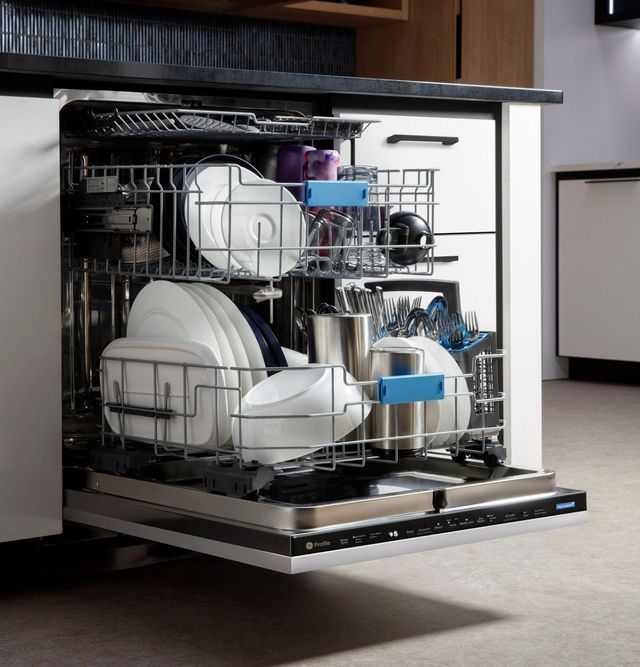
- Adjustable upper rack: Raises or lowers to make room for tall glasses on top or platters below.
- Deep third rack: The upper tray for cutlery, ramekins, and lids, and the deeper versions fit small bowls rather than only spatulas.
- Fold-down tines: Convert a row of plate slots into open space for a pot or a mixing bowl.
- Silverware basket versus third-rack cutlery: A basket holds more, a third rack frees the lower basket space and separates pieces better.
- Stemware support: Clips and rack shaping that keep wine glasses from tipping during the cycle.
Cycles and Capacity
Most machines in both lines offer heavy, normal, express or one-hour, and sanitize cycles, with specialty options such as bottle jets or a steam prewash appearing higher in each series. Capacity is stated in place settings, and the practical translation is simple: a couple rarely fills a standard twenty-four inch machine, while a family of five will use every rack every night.
One more honest point. Loading technique affects results more than the badge on the door. Dishes facing the center, nothing blocking the spray arms, and no bowl nested inside another will do more for your results than several hundred dollars of upgrade.
Drying, Noise Levels, and Everyday Livability
This section covers the two complaints that actually drive replacement purchases: wet plastics and noise.
Why Your Containers Come Out Wet
There are three approaches to drying. Condensation drying uses the residual heat of the final rinse and the cool stainless tub to pull moisture out of the air, with no heating element involved. It is efficient and gentle, and it works well on glass and ceramic, which hold heat. It works poorly on plastic, which does not hold heat and therefore never gets hot enough to evaporate the water sitting on it.
Heated dry adds an element, which improves plastic results and can risk warping lightweight items. Fan-assisted drying circulates air through the tub to carry moisture away, and it is the upgrade that genuinely solves the plastic problem. An auto door open feature, which pops the door slightly at cycle end to vent steam, is the other real fix and it costs nothing to run.
If wet containers are your complaint, fan-assisted drying is what you are shopping for, and it is available in higher trims of both lines.
Decibel Ratings in Real Terms
Dishwasher noise is rated in dBA, and the scale is compressed enough that small numbers matter. A rating in the high forties is clearly audible across an open kitchen and will be noticeable during a conversation at the island. Low forties fades into background sound. High thirties is genuinely hard to detect from the next room, which is what open-concept homes and houses with a bedroom near the kitchen actually need.
Quiet comes from insulation packed around the tub, better motor design, and wash arm engineering that moves water without splashing the door. All three cost money, which is why lower dBA correlates so closely with a higher price tier. It is one of the most reliable indicators in the category.
Cycle Length, Tubs, and Status Lights
Quiet and efficient generally means longer. A machine that runs a two-and-a-half hour normal cycle is using time in place of heat and water pressure, and the results are usually better, not worse. Express cycles exist for the nights when that does not work.
Stainless tubs help drying by holding heat and radiating it back at the load, and they resist odor and staining far better than plastic interiors over a decade. Finally, status indicators matter more than they sound: a floor beam projected onto the tile or a small door display tells you whether the cycle is finished without opening the door and interrupting the dry phase.
Smart Features and Connected Convenience
Both lines connect through the SmartHQ app, and connected capability has moved past novelty into features people use weekly.
The practical list is short and genuinely useful: remote start, cycle monitoring with remaining time, leak alerts, rinse aid and filter replacement reminders, and downloadable cycle updates. Remote start on a delay is the sleeper feature, since it lets the machine run overnight without anyone staying awake to press the button.
Software Updates Change the Math
Over-the-air updates mean a connected dishwasher can gain cycles and refinements after it is installed. That is a real shift in how to think about the purchase, because an appliance that improves during its first years is worth more than a static one at the same price. Most comparisons skip this entirely.
Remote diagnostics is the other underrated feature. When a machine reports an error code through the app, a service technician often knows the likely problem and the required part before the visit, which cuts return trips. That connects directly to why buying from a local dealer with its own service department matters.
Be careful with assumptions here. Connectivity is not universal across every model in either line, and the deeper features concentrate in higher trims. Confirm it on the specific model rather than assuming it comes with the badge.
Which GE Dishwasher Line Is Right for Your Kitchen
Rather than comparing features in the abstract, match your situation to the pattern that fits.
By Buyer Scenario
- Full remodel with a designer aesthetic: Cafe, almost always. The hardware program and the professional look are the reason the line exists, and in a kitchen where every finish was chosen deliberately, that consistency is worth the premium.
- Single appliance replacement in an existing kitchen: GE Profile, usually. When the surrounding appliances are stainless and the goal is a better machine rather than a new look, Profile puts the money into performance instead of hardware.
- Busy family focused on cleaning power: GE Profile in a higher series. Spend the budget on the wash system, the third rack, and fan-assisted drying rather than on handle finishes.
- Open-concept home where noise matters most: Either line, but shop by dBA rating rather than badge, and expect to move up a series to reach the high thirties.
- Rental or resale-focused upgrade: GE Profile. A stainless machine with strong specs appeals broadly, while a distinctive brushed brass handle is a personal taste that a future buyer may not share.
Where the Money Goes
In the Profile line, the premium over a base GE model buys wash system refinement, drying technology, and insulation. In the Cafe line, you get those same engineering benefits plus the design program. The honest test is simple: if you would not notice or change the handle finish, the design premium is not buying you anything, and the equivalent money spent on a higher Profile series buys measurable performance instead.
Suite Consistency and Installation
If your existing appliances come from a different tier or a different brand, decide whether you are matching the current kitchen or starting a gradual transition toward a new one. Both are valid, but drifting into a mismatched suite one appliance at a time is how kitchens end up looking unplanned.
Installation requirements are the same for both lines: a standard twenty-four inch cabinet cutout, hot water supply and drain connections, a dedicated circuit as the electrical code requires, and a properly built cabinet panel for panel-ready models. Warranty terms are comparable across the two, with extended coverage available, and both are handled by the same factory-authorized service network.
Where Buyers Regret Each Choice
Cafe regret usually sounds like paying a design premium in a kitchen where the dishwasher is half-hidden behind an island, or choosing a hardware finish that fights the rest of the room. Profile regret usually sounds like finishing a beautiful remodel and realizing the dishwasher is the one appliance that does not look intentional. Neither is a reliability complaint, which tells you something about how this decision really works.
GE Cafe Dishwasher vs GE Profile Dishwasher Side by Side
| Comparison Point | GE Cafe Dishwashers | GE Profile Dishwashers |
|---|---|---|
| Brand tier | Premium design-forward tier below Monogram | Mid-to-upper performance tier above GE |
| Design language | Professional-inspired with bar handles | Sleek, minimal, integrated handles |
| Hardware customization | Swappable handle kits in multiple finishes | Not offered, fixed factory hardware |
| Door finishes | Stainless, matte white, matte black, panel ready | Stainless, panel ready, select matte options |
| Control placement | Top control and front control options | Top control and front control options |
| Typical decibel range | Low forties down to high thirties | Mid forties down to high thirties |
| Wash system | Refined multi-jet systems in upper trims | Strong multi-jet systems across the range |
| Third rack | Deep third rack on most models | Third rack on mid and upper models |
| Drying technology | Fan-assisted dry on upper trims | Fan-assisted dry on upper trims |
| Smart capability | SmartHQ app on connected models | SmartHQ app on connected models |
| Best-fit buyer | Design-driven remodel or full suite | Performance-per-dollar upgrade |
Read the table down the rows that matter to you rather than across the whole thing. The genuine differences are concentrated in three rows: hardware customization, design language, and door finish range, and all three are aesthetic. The engineering rows look similar because they largely are similar, since both lines draw on the same wash, dry, and noise technology within their upper trims. That is the honest summary a spec sheet will never give you, and it is why the decision comes down to whether the look is worth the premium in your particular kitchen.
Framed simply, this is design investment versus performance value. A GE Cafe dishwasher earns its premium in specific situations rather than universally, and knowing which situation you are in is most of the decision.
Pros
Customizable hardware
Swappable handle kits in brushed brass, bronze, copper, black, and stainless let the look change without replacing the appliance.
Premium design presence
The professional-inspired proportions anchor a designed kitchen in a way a minimal front does not.
Refined wash and dry systems
Upper Cafe trims carry the strongest wash coverage and fan-assisted drying available in the family below Monogram.
Quiet operation
The design tier concentrates the insulation and motor engineering that pushes ratings toward the high thirties.
Full suite coordination
Matching a Cafe range, refrigerator, and dishwasher produces a consistency that mixed tiers cannot.
Cons
A real price premium
Comparable performance is often available in a higher GE Profile series for less money.
Part of the gap is stylistic
If the handle finish and the design language do not matter to you, you are paying for something you will not use.
What Coastal Virginia Water and Humidity Do to a Dishwasher
Two regional conditions change how these machines behave in Hampton Roads and Richmond, and no national comparison accounts for either. The first is humidity. In a Virginia summer, indoor air holds enough moisture that condensation drying has much less room to work, because the process depends on moisture moving from the dishes into drier air inside the tub. Households here notice damp plastics and lingering droplets far more between June and September than a buyer in Denver ever would, which pushes fan-assisted drying and an auto door open feature from a nice upgrade to the feature worth spending on. The second is water. Mineral content varies noticeably across the region depending on which utility serves you and whether the supply comes from surface reservoirs or groundwater, and harder water leaves the cloudy film on glassware that people mistake for a failing dishwasher.
- If your glasses come out chalky rather than gritty, that is mineral film from hard water, and a rinse aid plus a periodic citric acid cleaning cycle usually resolves it.
- Prioritize fan-assisted drying or an auto door open feature if your kitchen runs humid, which describes most homes here without whole-house dehumidification.
- Older homes in Norfolk, Portsmouth, and Church Hill sometimes have long hot water runs, so a dishwasher near the end of that run benefits from models that heat their own water.
- Storm-season power outages can interrupt a long quiet cycle, so look for models that resume rather than restart, and expect the app to show the interruption.
- Military families expecting a PCS move should think twice about panel-ready models, since the custom cabinet panel does not travel and the machine looks unfinished without it.
- Check the dedicated circuit and the hot water shutoff before delivery day in any home built before the 1990s, since both are common holdups on installation.
Top GE Cafe Dishwasher and GE Profile Dishwasher Picks
Straight talk before the lineup. Every dishwasher available in this group comes from the GE Profile line rather than the Cafe line, so if the comparison above pointed you toward Cafe hardware finishes, ask our appliance team about current Cafe availability or come see the handle kits in the showroom. What follows spans the Profile range from a panel-ready model built for full cabinet integration up through the higher series, plus a compact 18 inch option for tight kitchens. All of them install with a standard hookup and are delivered and installed by our own crews.
GE Profile™ 24” Panel Ready ENERGY STAR® Top Control Built-In Dishwasher with Microban™ Antimicrobial Technology

This is the one to buy when the dishwasher should not look like a dishwasher. The panel-ready front accepts a custom cabinet panel so the machine disappears into the run entirely, which is the same integration approach a Cafe panel-ready model uses at a lower price point. Top control placement keeps the face uninterrupted, ENERGY STAR certification keeps operating costs down on a machine that runs most nights, and Microban antimicrobial technology addresses the interior surfaces where moisture lingers. Best for a full remodel with custom cabinetry where visual continuity is the goal.
Top Features
- Panel ready front: Accepts a cabinet panel for complete integration into a run of custom cabinetry.
- Top control design: The control panel hides along the upper door edge, leaving a clean uninterrupted face.
- ENERGY STAR certified: Lower water and energy consumption on an appliance that runs several times a week.
- Microban antimicrobial technology: Built-in protection on interior surfaces where moisture and residue collect.
GE Profile™ 24” Fingerprint Resistant Stainless Steel Top Control Built-In Dishwasher
This is the highest series number in the group, which puts it at the top of the Profile range represented here and makes it the performance pick for a household that runs the machine every night. In the Profile line the upper series is where the wash coverage, the drying technology, and the sound insulation all reach their best combination, so this is the model to compare when quiet operation and dry plastics are both priorities. The fingerprint resistant stainless front handles a busy kitchen. Best for larger families and open-concept homes where the dishwasher runs during conversation.
Top Features
- Upper Profile series: The top tier represented in this lineup, where the strongest feature combination lives.
- Top control placement: Hidden controls for a clean front in a continuous cabinet run.
- Fingerprint resistant stainless steel: Stays presentable in a kitchen that gets used hard.
- Built-in 24 inch installation: Drops into the standard cutout with a conventional water, drain, and electrical hookup.
GE Profile™ 24” Fingerprint Resistant Stainless Steel Built-In Top Control Dishwasher

The middle series is where most shoppers land, and for good reason. It sits above the entry Profile trims on features while stopping short of the top-series premium, which is the definition of performance per dollar in this comparison. Fingerprint resistant stainless and top control placement give it the same clean face as the more expensive models in this group, so the visual difference in an installed kitchen is minimal. Best for a single appliance replacement in an existing stainless kitchen, where the goal is a better machine rather than a new look.
Top Features
- Mid-series Profile positioning: The performance-per-dollar sweet spot between entry and top trims.
- Top control panel: A clean front that matches the rest of the stainless appliances in the room.
- Fingerprint resistant finish: Practical in a household where the dishwasher door gets touched constantly.
- Standard 24 inch built-in fit: A straightforward swap for an existing dishwasher in the same cutout.
GE Profile™ 24” Fingerprint Resistant Stainless Steel Built-In Top Control Dishwasher

This is the close companion to the model above, sharing the same series level, the same fingerprint resistant stainless finish, and the same twenty-four inch built-in format, with a different model prefix that points to a difference in configuration rather than tier. Because the two are so similar on paper, ask our appliance team to compare the rack layout and control details directly before you order, since that is what separates them. Everything covered above about mid-series value applies here equally. Best for shoppers weighing two nearly identical Profile options who want the right one for their kitchen.
Top Features
- Same mid-series tier: Matches its companion model on positioning and core capability.
- Fingerprint resistant stainless steel: A clean, low-maintenance front for a busy kitchen.
- Top control operation: Controls tucked along the door edge rather than across the face.
- Configuration worth confirming: Have our team compare rack layout and control details against the companion model before ordering.
GE Profile™ ENERGY STAR® 24” Fingerprint Resistant Stainless Steel Top Control Built-In Dishwasher with Microban™ Antimicrobial Technology

This model pairs ENERGY STAR certification with Microban antimicrobial technology in a stainless finish, which makes it the practical efficiency pick in the group. Running a dishwasher four or five nights a week for a decade turns efficiency from a talking point into real money, and the Microban treatment addresses the interior surfaces that stay damp between cycles, which is a genuine consideration in a humid coastal climate. Top control placement keeps the front clean. Best for efficiency-minded households and for anyone replacing an older machine that was never certified.
Top Features
- ENERGY STAR certification: Meaningful water and energy savings across years of nightly operation.
- Microban antimicrobial technology: Protection built into interior surfaces where moisture lingers between cycles.
- Fingerprint resistant stainless steel: A finish that looks maintained without constant wiping.
- Top control layout: Clean face with controls hidden along the door edge.
GE Profile™ ENERGY STAR® 24” Fingerprint Resistant Stainless Steel Top Control Built-In Dishwasher with Microban™ Antimicrobial Technology

The companion to the model above, matching it on ENERGY STAR certification, Microban antimicrobial technology, and the fingerprint resistant stainless finish, with a different model prefix indicating a configuration difference rather than a step up or down. As with the other paired listings here, the practical way to choose between them is to have our team compare the interior layout and control specifics side by side. The efficiency and antimicrobial benefits described above are identical. Best for shoppers who have narrowed the search to this efficiency tier and want help picking between two close siblings.
Top Features
- ENERGY STAR certified: The same efficiency credential as its companion model.
- Microban antimicrobial technology: Interior surface protection against residue and moisture.
- Fingerprint resistant stainless steel: Practical for households where the door is touched all day.
- Compare before ordering: Ask our team to lay this one next to its companion so the differences are visible.
GE Profile™® 18” Stainless Steel Built In Dishwasher
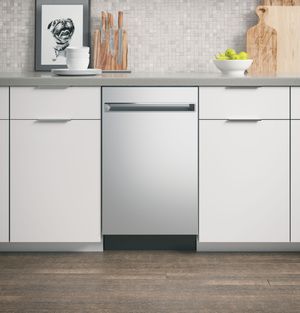
Not every kitchen has twenty-four inches to give, and that is exactly what this compact model is for. At 18 inches wide it fits galley kitchens, condos, bar areas, and the tight footprints common in older Norfolk row houses and Richmond apartments, and it does so with a real stainless built-in dishwasher rather than a portable unit on wheels. For a couple or a single person, an 18 inch machine also fills up in a day instead of sitting half-loaded for three. Best for compact kitchens, condos, and secondary bar or pantry installations where a standard machine simply will not fit.
Top Features
- 18 inch compact width: Fits cabinet openings where a standard 24 inch dishwasher cannot go.
- Built-in installation: A permanently installed machine rather than a portable, with a finished look.
- Stainless steel front: Coordinates with a stainless kitchen at a smaller scale.
- Right-sized capacity: Fills up in a day for a couple or a single-person household instead of running half empty.
Choose the Right GE Cafe Dishwasher for Your Kitchen
Both lines share GE Appliances engineering and the same factory-authorized service network, so this is not a reliability decision. Cafe leads on customizable hardware and premium design presence, while GE Profile usually delivers the stronger performance per dollar, particularly if you spend the difference on a higher series with fan-assisted drying and better sound insulation. Decide whether the design premium buys something you will actually notice in your kitchen, and the rest follows.
Come compare them in person. Shop GE Cafe and GE Profile dishwashers at East Coast Appliance or visit a showroom in the Hampton Roads or Richmond area, where our staff can put the hardware finish options side by side, show you the rack layouts, and tell you honestly when the premium is not worth paying. Our own crews handle professional installation including water, drain, and electrical connections, and our local factory-authorized service team is here years after the sale. At a big-box store the two lines sit unlabeled in the same aisle and both installation and service are outsourced to whoever is available. Stop in or contact our team for a straight recommendation.
Read more:
Plastic vs Stainless Steel Dishwasher Tubs | Is There a Difference?
Most Popular Miele Dishwasher + Features
Frequently Asked Questions about GE Cafe Dishwashers
A GE Cafe dishwasher sits one tier above GE Profile as the design-forward premium line, with professional-inspired styling and a customizable hardware program that GE Profile does not offer. GE Profile focuses the same underlying engineering on performance per dollar, which is why upper Profile series often match Cafe machines on wash, dry, and noise specifications for less money.
A GE Cafe dishwasher is worth the premium in a designed kitchen where the handle finish, the professional proportions, and the matching suite all matter to how the room reads. If the dishwasher sits half-hidden behind an island or the surrounding appliances are already stainless, that same money buys more measurable improvement in a higher GE Profile series.
Yes, Cafe and GE Profile are both brands of GE Appliances, built with shared engineering and components and covered by the same factory-authorized service network. The brand ladder runs Hotpoint, GE, GE Profile, Cafe, and Monogram, so the difference between these two is positioning and feature depth rather than manufacturer.
The quietest machines in either line are the upper-series models that reach the high thirties in dBA, where added tub insulation, refined motor design, and better wash arm engineering all come together. Shop the decibel rating on the specific model rather than the badge, since a high-series GE Profile dishwasher can be quieter than an entry Cafe model.
Yes, swappable handle hardware is the flagship feature of the Cafe line, with kits available in finishes including brushed brass, brushed bronze, brushed copper, brushed black, and brushed stainless. Because the hardware attaches to the appliance rather than being fixed at the factory, the look can be changed years later for the cost of a kit instead of a new dishwasher.
Warranty terms are comparable across the two lines and both are supported by the same GE Appliances factory-authorized service network, with extended coverage available on either. What changes the real-world experience is where you buy, since a local dealer with its own service department handles the repair directly rather than routing it to a third party.