

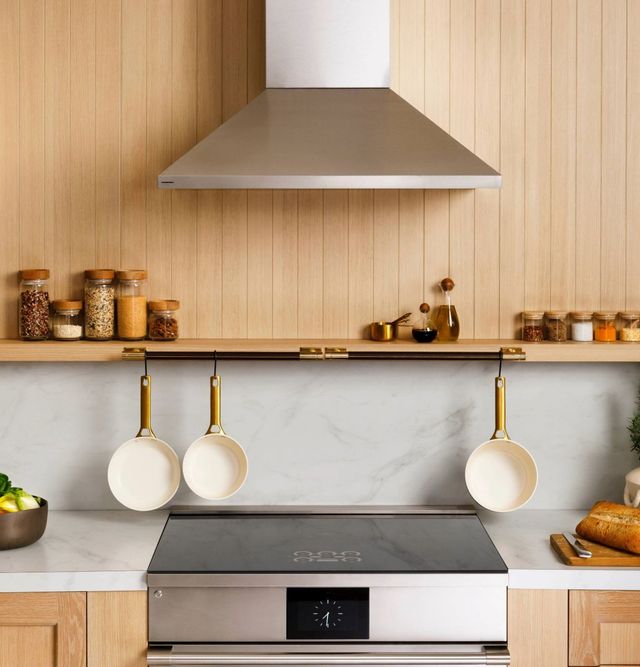
Two ribeyes hit a cast iron pan, the smoke rolls straight up and then sideways across the ceiling, and forty seconds later the detector in the hallway starts screaming while somebody waves a dish towel at it. The fan over the range is running on high and doing almost nothing, because it is too narrow, mounted too high, and pushing air through a duct that turns three times before it gets anywhere. That is the daily reality in a lot of kitchens, and it is exactly the problem a properly sized wall mount range hood solves. The grease film that keeps coming back on the cabinet doors is the same story told slowly.
Get Kitchen Ventilation That Actually Clears the Air
East Coast Appliance carries wall mount, under cabinet, island, and insert ventilation from the brands that build it well, with showroom staff who size hoods to real kitchens across Hampton Roads and Richmond. Our own crews handle professional installation, duct work, and service after the sale.
The fix is more straightforward than most homeowners expect, and it starts with three numbers rather than a brand name. At East Coast Appliance, our team sizes ventilation for kitchens from Virginia Beach and Suffolk to Midlothian and Glen Allen, including plenty of 1940s houses where the duct has to fight its way through brick. This guide covers how a wall mount range hood works, how to size width, depth, and mounting height, how to calculate the CFM your cooking actually requires, the ducted versus ductless decision, styles and finishes, noise and filters, installation planning, and a comparison of every configuration side by side.
Key Takeaways
- Width and mounting height beat brand every time: A hood that matches or exceeds the cooktop width and hangs at the correct distance will outperform a more expensive hood installed wrong.
- Rated CFM is a ceiling, not a promise: Duct length, diameter, elbows, and the exterior cap all subtract from the number printed on the box, so plan the duct run before you pick the blower.
- Ducted beats recirculating on every measure that matters: Venting outside removes grease, moisture, and odor, while a ductless hood only filters odor and returns heat and humidity to the room.
- Sones tell you whether you will actually run it: A hood you leave off because it is loud provides exactly zero ventilation, which is why speed range and blower placement matter as much as peak airflow.
What a Wall Mount Range Hood Is and How It Works
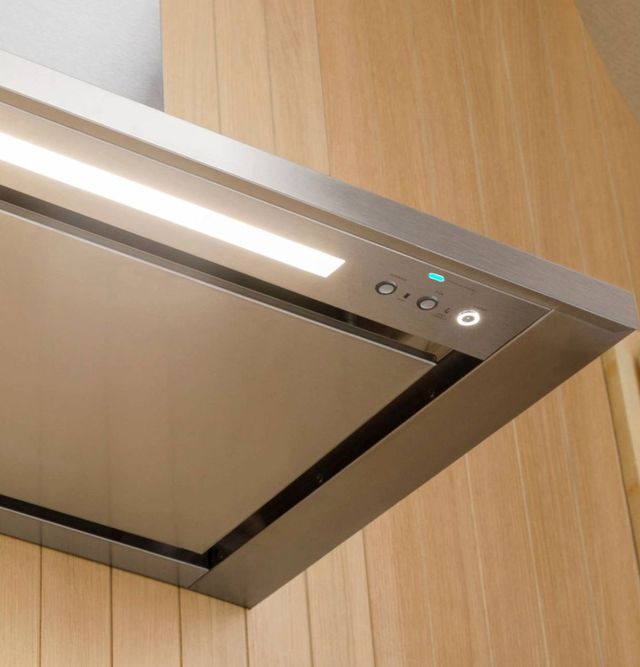
A wall mount range hood attaches directly to the wall above a range or cooktop with no cabinet above it, and it usually carries a visible chimney or duct cover that runs up toward the ceiling. That open installation is the defining trait. Nothing boxes it in, so the canopy can be deeper and wider than a hood squeezed under a cabinet.
The mechanics are simple. A canopy creates a capture area that holds rising smoke and steam long enough for the blower to pull it in, the blower moves that air into ductwork, and the duct carries it to an exterior termination on the roof or a side wall. Capture area and canopy depth do the quiet work here. A blower can only exhaust what the canopy catches.
How It Differs From Every Other Ventilation Type
Category confusion causes more bad purchases than any spec on the sheet. The differences are worth knowing before you shop:
- Under cabinet hood: Mounts beneath an existing upper cabinet, which limits canopy depth but preserves storage above the range.
- Island hood: Hangs from the ceiling over an island cooktop, exposed on all four sides, so it needs more airflow to fight cross drafts.
- Insert or liner hood: A blower and filter assembly with no finished exterior, installed inside a custom wood or plaster surround.
- Downdraft system: Pulls air sideways at cooktop level instead of capturing it as it rises, which works against physics and generally underperforms.
- Over-the-range microwave: A combination appliance with modest ventilation, chosen mostly to save space rather than to move air.
What Ventilation Actually Removes
Good ventilation pulls out grease particulate, smoke, steam, heat, cooking odors, and the combustion byproducts that gas cooking produces. Those first two are why it matters beyond comfort. Airborne grease settles on cabinet finishes, painted drywall, and the tops of upper cabinets, and steam that stays in the room ends up in the paint and the trim. Indoor air quality and the condition of your kitchen surfaces are the same conversation.
How to Size a Wall Mount Range Hood Correctly
Sizing is where most of the performance is won or lost, and it comes down to width, canopy depth, and mounting height.
Read more:
Range Hood Installation - Everything You Need to Know
Width Comes First
The rule is simple: the hood should be at least as wide as the cooking surface. Going wider improves capture noticeably, and a wall mount range hood benefits more from extra width than an under cabinet model does because its sides are fully open to the room. Three inches of overhang on each side is a common upgrade and it makes a real difference when a pan sits toward the front edge.
Common widths map cleanly to ranges:
- 30 inch hoods for a standard 30 inch range, or 36 inch for better capture
- 36 inch hoods for a 36 inch range or cooktop, or 42 inch for overhang
- 42 inch hoods for wide cooktops and light professional ranges
- 48 inch and larger for pro-style ranges with six or more burners
- 60 inch for the widest professional ranges, usually paired with a high-output blower
Canopy Depth and Mounting Height
Canopy depth has to cover the front burners, not just the back ones. Most of the searing, frying, and boiling that generates smoke happens on the front of the cooktop, and a shallow canopy lets all of it escape into the room.
Mounting height is a genuine balance. Hang the hood too high and capture efficiency drops sharply, since smoke has room to spread before it reaches the canopy. Hang it too low and you create head clearance problems and expose the hood to more heat than it was designed for. Electric cooktops generally allow a slightly lower mount than gas, and gas ranges need more clearance because of the open flame and higher heat output. Follow the manufacturer specification for the exact model rather than a general rule, because the acceptable range varies more than most people expect.
Ceilings Above Eight Feet
Chimney covers are sized for a standard ceiling. Nine foot, ten foot, and vaulted ceilings need an extension kit, and that kit is model specific. This is the detail most competing guides skip entirely, and it is the reason a hood sometimes arrives with a visible gap of bare duct above the chimney. Order the extension with the hood, not after.
Measure These Before You Shop
- 1. Range or cooktop width, measured at the cooking surface
- 2. Available wall width between cabinets or walls
- 3. Cabinet clearance on each side, including any crown molding
- 4. Ceiling height at the hood location
- 5. Existing duct location, diameter, and whether it runs up or out
- 6. Distance from the cooking surface to the ceiling
Calculating the CFM Your Kitchen Actually Needs
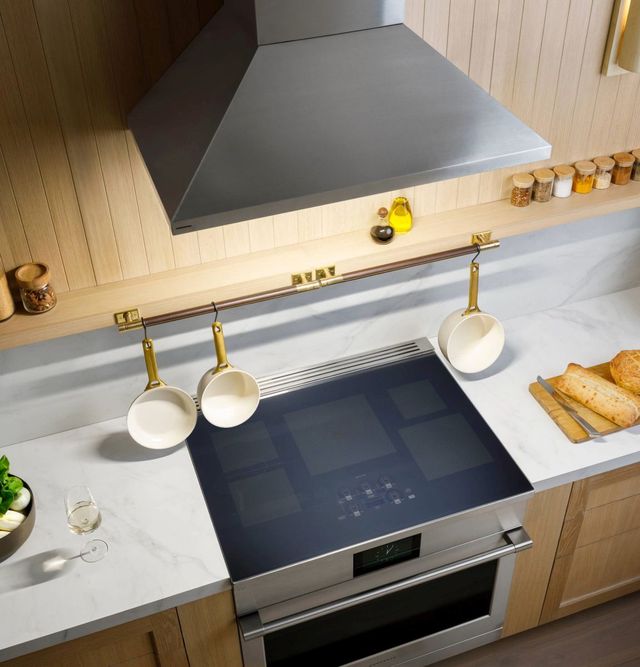
CFM stands for cubic feet per minute, the volume of air a hood moves, and it is the most misunderstood number in the category. Higher is not automatically better.
The Two Common Sizing Approaches
For an electric range, sizing generally follows cooktop width, since electric output is relatively consistent across the surface. Wider cooking surface, more airflow. For a gas range, sizing follows total BTU output, because gas cooking adds combustion byproducts and considerably more heat, and a high-output professional range can demand several times the airflow of a standard one. Both approaches are starting points that get adjusted for the room and the duct run, not formulas that produce a single correct answer.
Why Rated CFM Is a Ceiling
The number on the box is measured under ideal conditions. Your kitchen is not ideal. Every foot of duct, every elbow, every reduction in diameter, and the exterior cap itself all add static pressure, and static pressure subtracts real airflow. A long run through an attic with three turns and a restrictive cap can cost a meaningful share of the rated performance.
That is why duct planning is not a detail to hand off. Short, straight, smooth, and correctly sized beats a bigger blower fighting a bad duct every time.
Cooking Style Changes the Answer
- Frequent high-heat searing and cast iron cooking produces heavy smoke and needs more airflow.
- Wok cooking generates intense heat and oil vapor in short bursts, which favors a strong top speed.
- Regular deep frying puts more grease into the air than any other technique.
- Light cooking, mostly baking and boiling, needs far less than the marketing suggests.
Makeup Air, Explained Plainly
A powerful hood pushes a lot of air out of the house, and that air has to be replaced from somewhere. In an older, leaky house it comes in around windows and doors without anyone noticing. In a tightly sealed newer home it can create negative pressure, which pulls air backward down a chimney or a water heater flue. Local code often requires a makeup air system above a certain CFM threshold, and that threshold varies by jurisdiction. Confirm the requirement with your locality before buying a high-output hood, because retrofitting makeup air after drywall is expensive.
The practical takeaway is that maximum CFM is not a goal in itself. More airflow means more noise, more makeup air complexity, and a hood that gets run on low most of the time anyway.
Ducted Versus Ductless Wall Mount Range Hood Options .
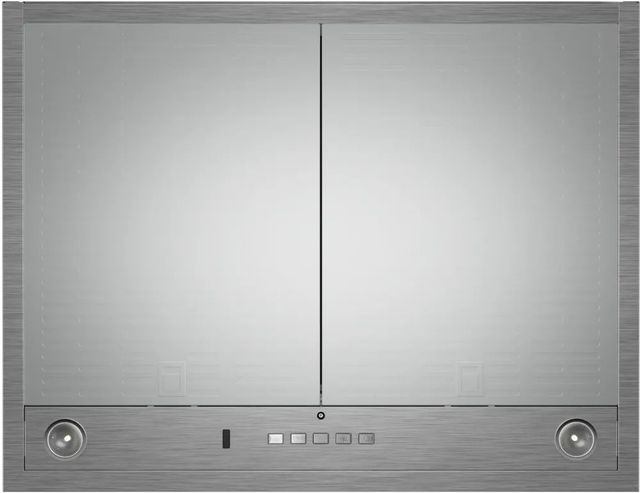
This decision determines what your ventilation can actually accomplish, so make it before you fall in love with a finish.
Ducted, or Vented
A ducted hood exhausts air outside through the roof or an exterior wall. Grease, smoke, moisture, heat, and odor all leave the building. It is the higher performing option by a wide margin, and it is the only configuration that removes humidity from the room, which matters more in coastal Virginia than in most of the country.
Ductless, or Recirculating
A ductless hood pulls air through a grease filter and then a charcoal or carbon filter, and returns it to the room. It captures some odor and some grease, but the heat and the moisture stay in the kitchen. It is a fallback for condos, apartments, interior walls, and situations where exterior venting genuinely is not possible, not a preference.
Many hoods are convertible, shipping ducted with a recirculating kit available. If exterior venting is impossible now but possible during a future remodel, a convertible hood keeps that door open.
Duct Sizing and Material
- Round duct outperforms rectangular duct of equivalent area because it moves air with less resistance.
- Larger diameter is better, and never reduce below the manufacturer specification for the blower.
- Smooth rigid metal duct beats flexible duct by a wide margin, since the corrugations in flex duct create constant turbulence.
- Every elbow costs airflow, so minimize turns and keep the run as short and straight as the house allows.
- Seal joints properly and slope any horizontal run slightly toward the exterior.
Filter Maintenance Differs
Ducted hoods use washable metal filters, either baffle or mesh, that go back into service after cleaning. Ductless hoods add charcoal filters that cannot be washed and must be replaced on a schedule, commonly every few months depending on how much you cook. That recurring cost is part of the true price of a recirculating setup.
Styles, Finishes, and Design Considerations
A wall mount range hood is the one appliance hanging at eye level with nothing around it, so its appearance carries more weight than any other piece in the kitchen.
Style Families
- Classic stainless chimney: The default, with a tapered canopy and a straight chimney cover, at home in almost any kitchen.
- Glass and stainless canopy: A flat or curved glass panel that lightens the visual weight, popular in contemporary and transitional kitchens.
- Pyramid or T-shape: Angled canopies that read as architectural rather than appliance-like.
- Wood, plaster, or tile clad custom surround: Built around an insert hood, this turns ventilation into millwork.
- Pro-style commercial look: Heavy stainless, wide, with a squared canopy and higher output, matched to a professional range.
Finishes and Surroundings
Brushed stainless remains the safe center. Black stainless, matte black, and white each coordinate with a specific cabinet direction, and custom paneling disappears the hood into cabinetry entirely. Think about the backsplash at the same time, because the hood sets the height where tile stops and open shelving begins. In a kitchen with upper cabinets on both sides, the hood becomes the centerpiece of that run whether you planned it or not.
Lighting and Controls
LED lighting has largely replaced halogen, runs cooler, and lasts far longer. Look for dimmable levels rather than a single brightness, because the light over a cooktop gets used as ambient evening lighting far more often than as task lighting. Controls come as push button, rotary knob, capacitive touch, and app-connected panels, and the better connected models include auto-sensing that raises fan speed when heat or smoke increases without anyone touching it.
Keeping It Proportional
Scale is easy to get wrong. In a small kitchen, a massive pro-style canopy in a heavy finish visually shrinks the room, while a glass canopy at the same width feels half the size. In a large open kitchen the opposite risk applies, and an undersized hood looks like an afterthought hanging on a big wall. Match the visual weight to the wall, not to the budget.
Noise, Filters, and Long-Term Maintenance
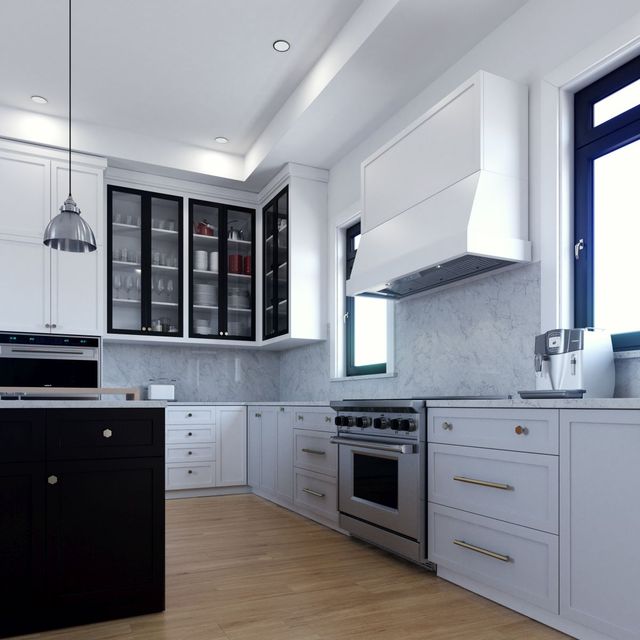
The hood you actually run is the one that ventilates your kitchen, and noise decides whether you run it.
Understanding Sones
Sones measure perceived loudness rather than raw decibels, which makes them a useful practical frame. A low sone rating at normal speed reads as background noise you can talk over. A moderate rating is clearly audible but tolerable. A high rating at top speed is the setting nobody uses twice during a dinner party. The number that matters most is the rating at the speed you will actually cook on, not the rating at maximum.
Fan speed, CFM, and noise rise together, which is why a hood with four or six speeds is more useful than one with two. More increments means running on a quieter setting most nights and saving full power for the smoky loads.
Inline and Remote Blowers
The quietest option is to move the motor away from the kitchen. An inline blower sits in the duct run, often in the attic, while a remote blower mounts at the exterior termination. Both cut kitchen noise dramatically because the loudest component is no longer above your head. Most competing guides skip this entirely, and it is one of the best upgrades available for an open-concept kitchen where the range sits fifteen feet from the sofa.
Filter Types
- Baffle filters: Stainless steel channels that force air to change direction so grease condenses and drains, standard on pro-style hoods, dishwasher safe and long-lived.
- Mesh or aluminum filters: Layered screens common on lighter-duty hoods, also washable, but they clog faster and restrict airflow more as they load up.
- Charcoal filters: Odor absorption for recirculating setups only, not washable, replaced on a schedule.
Routine Care
Clean metal filters every month or two depending on how much you fry, degrease the canopy interior on the same schedule, inspect the duct run and exterior cap annually, and pay attention to changes in sound or airflow that suggest the blower needs service. Neglected filters are the single most common cause of a hood that seems to lose power over time, and manufacturers can deny warranty claims for damage caused by grease buildup.
Installation Requirements and Planning Checklist
Installation is where a good hood either performs or disappoints, and most of it is decided before anyone picks up a tool.
What the Job Involves
Wall structure and stud location determine how the hood is supported, since a large stainless canopy is heavy and a chimney adds leverage. Most hoods need a dedicated electrical supply run to the mounting location, and higher-output blowers may need their own circuit. Then comes the duct: routing it up through the ceiling and roof or out through an exterior wall, sized correctly, with a properly selected cap at the end.
Replacing an Over-the-Range Microwave
This retrofit is more common than any other and rarely covered honestly. Swapping a microwave for a wall mount range hood means removing the cabinet above the range, repairing and finishing the wall and any surrounding cabinetry, and almost always adapting the duct, because microwave venting is typically a smaller rectangular transition that a real hood should not be asked to use. The electrical outlet usually sits inside the old cabinet and has to be relocated. Budget for wall repair and paint, not just the appliance.
New Construction and Full Remodels
Plan ventilation before drywall. Duct routing, blower location, electrical, and any makeup air provision are all inexpensive decisions at framing and expensive ones afterward. If a hood is going over an island or against an exterior wall with a tight cavity, that conversation belongs in the framing stage.
Permits, Code, and Professional Installation
Electrical work and exterior penetrations are commonly permitted work, and makeup air requirements vary by locality, so confirm what your jurisdiction expects. Professional installation matters here beyond convenience: proper support, correct duct sizing and sealing, an exterior cap installed with the right flashing and slope, and documentation that keeps the manufacturer warranty intact. A poorly sealed roof penetration in a region that sees tropical rain is not a theoretical problem.
Final Pre-Purchase Checklist
- 1. Confirm cooktop width, fuel type, and total BTU output if gas
- 2. Measure the wall opening, ceiling height, and duct location
- 3. Decide ducted or recirculating before choosing a model
- 4. Map the duct run and count the elbows
- 5. Check whether a chimney extension kit is needed
- 6. Verify electrical supply at the hood location
- 7. Ask about local makeup air requirements for high-CFM models
- 8. Order the correct exterior cap along with the hood
Wall Mount Range Hood Configurations Compared
| Configuration | Venting Method | Typical CFM Range | Grease and Odor Removal | Noise and Maintenance | Best-Fit Scenario |
|---|---|---|---|---|---|
| Ducted wall mount range hood | Exhausts outside through roof or wall | Moderate to high | Removes grease, smoke, moisture, and odor | Moderate noise, washable metal filters | Avid home cook with exterior access |
| Ductless recirculating wall mount | Filters and returns air to the room | Low to moderate | Odor only, heat and humidity stay inside | Similar noise, ongoing charcoal filter cost | Condo or interior wall with no duct path |
| Under cabinet hood | Ducted or recirculating | Low to moderate | Good, limited by shallow canopy depth | Generally quieter at lower output | Budget refresh that keeps cabinet storage |
| Over-the-range microwave | Ducted or recirculating | Low | Modest, weakest of the group | Loud for the airflow delivered | Small kitchen that needs both appliances |
| Pro-style wall hood | Ducted, often with remote blower | High to very high | Best in class on grease and smoke | Quietest per CFM with a remote blower | Professional range or new construction |
Read the table by the row that matches your kitchen, not the row with the biggest numbers. The performance gap between ducted and ductless is the widest in the chart and the least negotiable, since a recirculating hood returns the heat and steam it just collected. The gap between an over-the-range microwave and a real hood is nearly as large, and it is the upgrade that surprises people most after installation.
A wall mount range hood delivers the strongest combination of capture performance and visual presence available in a residential kitchen, and it comes with a few real trade-offs that are worth understanding before the cabinet above the range comes down.
Pros
Best-in-class capture:
An open canopy with full depth catches smoke and steam that a shallow under cabinet hood lets escape.
A genuine design statement:
The hood becomes the focal point of the range wall, in stainless, glass, black, or custom cladding.
The widest size range available:
From 30 inch models up to 60 inch pro-style canopies, so it scales to any cooking surface.
High-CFM and quiet blower options:
Inline and remote blowers deliver serious airflow while moving the noise out of the room.
Cons
You lose the cabinet above the range:
That storage does not come back, which is a real cost in a small kitchen.
Installation is more demanding:
Wall support, relocated electrical, duct adaptation, and wall repair make this more than a simple appliance swap.
Coastal Virginia Ventilation: Salt Air, Seafood, and Storm-Season Wall Caps
Kitchen ventilation in Hampton Roads faces conditions a national buying guide never accounts for. Summer humidity here is high enough that a recirculating hood is close to pointless, since the moisture it returns to the room has nowhere to go and shows up later as condensation and mildew on the coldest surface in the kitchen. The cooking is different too. A Tidewater household steaming crabs, frying spot and croaker, or boiling shrimp in Old Bay puts far more moisture and odor into the air in one evening than a week of ordinary cooking, and that argues for ducted venting and more airflow than a spec sheet would suggest. Add exterior brick or block walls on older homes in Norfolk, Portsmouth, and Church Hill, and the fact that most Hampton Roads houses sit on a slab or crawlspace with no basement chase, and duct runs usually end up going straight up through an attic to the roof.
Here is the detail our installers pay attention to on every coastal job: replace the flimsy plastic louvered wall cap with a metal cap that has a spring-loaded backdraft damper and a bird guard, and skip any cap with a fine insect screen, because grease loads that screen shut within a season and quietly strangles the hood. A proper damper also stops storm-driven wind from pushing air and rain back down the duct during a nor’easter, which is the second most common ventilation complaint we hear after weak airflow.
- Choose 304-grade stainless or a quality finish if you live within a few miles of open water, since salt air is hard on cheaper exterior hardware.
- Insist on a metal wall or roof cap with a working damper, properly flashed and sealed for wind-driven rain.
- Plan the duct run through the attic on slab and crawlspace homes, keeping it short and insulated where it crosses unconditioned space.
- Expect brick and block exterior walls in older neighborhoods to make a side-wall penetration more expensive than a roof run.
- Size up on airflow if you regularly steam, boil, or fry seafood, and prioritize a quiet mid-speed you will actually use.
- Ask about makeup air requirements in newer, tightly built homes in Chesapeake, Suffolk, and the western Richmond suburbs.
Best Wall Mount Range Hood Picks for Every Kitchen
The lineup below covers the full range of wall-installed ventilation, from true wall mount chimney hoods to the pro-style under cabinet, insert, and island options discussed earlier, so you can match the configuration to your cabinetry rather than the other way around. Widths run from 30 inches to 60 inches here, which spans everything from a standard apartment range to a professional cooking suite. Every one of these is available through East Coast Appliance with professional installation and duct work by our own crews.
Café™ 30” Stainless Steel Wall Mount Glass Canopy Chimney Hood
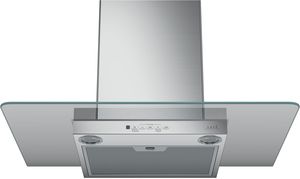
This is the design-forward wall mount range hood for a standard 30 inch range, and the glass canopy is the reason. Glass lightens the visual weight of a hood hanging at eye level, so a compact kitchen keeps its sense of openness while still getting a real chimney hood with full canopy depth. Stainless and glass together coordinate with nearly any cabinet color, from white shaker to walnut. Best for contemporary and transitional kitchens with a 30 inch cooking surface where the homeowner wants the hood to look intentional rather than industrial.
Top Features
- 30 inch wall mount width: Matches a standard 30 inch range, with the open sides that give wall mount hoods their capture advantage.
- Glass canopy design: Reduces visual bulk on the range wall while keeping the depth needed to cover front burners.
- Chimney cover included: Conceals the duct run cleanly, with extension kits available for taller ceilings.
- Café design family: Coordinates with the rest of a Café suite for a matched kitchen.
Café™ 36” Stainless Steel Wall Mount Glass Canopy Chimney Hood
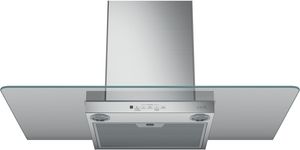
The same glass canopy design in a 36 inch width, which is the sweet spot for two very different buyers. Put it over a 36 inch cooktop for a matched installation, or over a 30 inch range to gain three inches of overhang on each side, which measurably improves capture on the front burners where most of the smoke starts. That overhang trick is one of the easiest performance upgrades available in this category and costs far less than stepping up a blower tier. Best for kitchens with wall space to spare and cooks who want capture performance without a commercial look.
Top Features
- 36 inch canopy width: Fits a 36 inch cooktop directly or provides overhang on a 30 inch range.
- Improved capture area: Extra width on each side catches smoke that drifts forward and outward off the pan.
- Glass and stainless finish: A lighter, more contemporary look than a full stainless canopy.
- Wall mount chimney configuration: Open sides and full depth, the strongest residential ventilation geometry.
Thermador® Pro Harmony® 48” Stainless Steel Under Cabinet Range Hood
Shop Under Cabinet Range Hoods
At 48 inches wide, this is professional-grade ventilation built to sit over a serious cooking suite. The Pro Harmony line is designed around ranges that put out real heat, which is exactly the situation where undersized ventilation fails most visibly, and the wide stainless canopy covers every burner on a six-burner or griddle-equipped range. It installs under a cabinet or a custom surround rather than as a freestanding chimney, so it suits a kitchen where the upper run continues across the range wall. Best for homeowners pairing it with a 48 inch professional range in a full remodel.
Top Features
- 48 inch professional width: Full coverage for a wide pro-style range, including front burners and griddle areas.
- Thermador Pro Harmony pedigree: Ventilation engineered to match the heat output of the brand’s professional cooking equipment.
- Stainless steel construction: Durable, cleanable, and consistent with a professional appliance suite.
- Under cabinet installation: Fits a continuous cabinet run where a chimney hood would break the line.
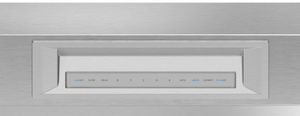
Thermador® Pro Grand® 60” Stainless Steel Under Cabinet Range Hood
Shop Under Cabinet Range Hoods
Sixty inches is the top of the residential ventilation category, and it exists for one reason: a Pro Grand cooking suite generates more heat, smoke, and grease vapor than any standard hood can handle. If your range is that wide, nothing narrower will keep the air clear, and this is the matched answer rather than a compromise. Plan this one carefully, because a hood at this scale is where duct sizing, blower selection, and makeup air requirements all become part of the conversation. Best for a serious cooking kitchen built around a Thermador Pro Grand range.
Top Features
- 60 inch maximum width: The widest canopy in this lineup, sized to the largest professional ranges.
- Pro Grand suite matching: Designed to pair visually and functionally with Thermador’s flagship cooking line.
- Heavy stainless build: Commercial-inspired construction for a kitchen that cooks hard and often.
- Plan-ahead installation: A hood at this scale rewards early duct and makeup air planning during a remodel.
Monogram® 36” Stainless Steel Island Range Hood
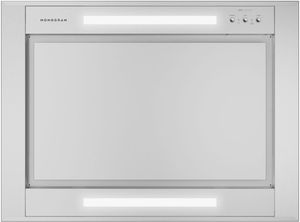
When the cooktop moved to the island, ventilation got harder, and this is the answer for that layout. An island hood hangs from the ceiling and is exposed on all four sides, so it faces cross drafts from every direction that a wall-mounted hood never deals with. Monogram builds this one at 36 inches with the finished appearance a suspended hood needs, since it is visible from every seat in an open-concept room. Best for open kitchens with an island cooktop, especially in newer homes across Chesapeake and the Richmond suburbs where island cooking is the standard layout.
Top Features
- 36 inch island configuration: Sized for a standard island cooktop and finished on all four sides.
- Ceiling-suspended installation: Requires overhead duct routing planned during framing or remodel.
- Monogram luxury finish: Built to be seen from across an open living space, not hidden against a wall.
- Open-layout ventilation: Designed for the harder capture conditions an island creates.
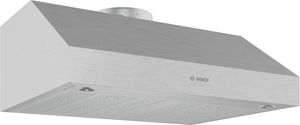
Bosch® 800 Series 30” Stainless Steel Under Cabinet Range Hood
Shop Under Cabinet Range Hoods
Bosch built its reputation on quiet, well-engineered appliances, and that is the argument for this 30 inch under cabinet hood. It is the practical upgrade for anyone replacing an over-the-range microwave who wants real ventilation without giving up the cabinet above, since it mounts in the same location with a proper hood underneath. The 800 Series sits at the upper end of the Bosch line, which is where the better blower engineering and finish quality live. Best for a kitchen refresh in a standard 30 inch range opening where storage cannot be sacrificed.
Top Features
- 30 inch under cabinet fit: Drops into the standard opening left by a microwave or older hood.
- Bosch 800 Series engineering: The brand’s upper tier, where quieter operation and refined controls are the differentiators.
- Keeps cabinet storage: Real ventilation without removing the cabinet above the range.
- Stainless steel finish: Coordinates with a stainless suite and wipes clean easily.
XO Fabriano Collection 34” Stainless Steel Insert Range Hood
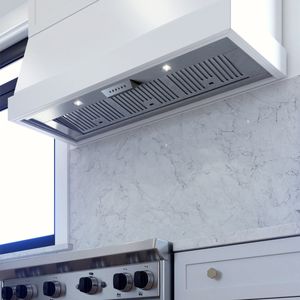
An insert hood is the choice when you want the ventilation to be invisible and the surround to be the design. This 34 inch XO Fabriano unit is the blower, filters, and lighting assembly that gets built into a custom wood, plaster, or tile hood surround, which is one of the strongest looks available in a kitchen remodel right now. The 34 inch width fits comfortably inside a surround built over a 30 inch range with room for the framing. Best for homeowners working with a cabinetmaker or designer on a custom range wall.
Top Features
- 34 inch insert width: Sized to fit inside a custom surround built over a standard range.
- Built-in configuration: Only the underside is visible, so the surround defines the look entirely.
- XO Fabriano Collection: A dedicated ventilation brand focused on inserts and liners for custom installations.
- Stainless construction: Cleanable interior surfaces where grease actually collects.
Find the Right Wall Mount Range Hood for Your Kitchen
Correct sizing and a realistic view of CFM matter far more than any headline spec, ducted venting outperforms recirculating on every measure that affects your kitchen, and style should follow the performance requirements rather than lead them. Get the width, the mounting height, and the duct run right, and almost any quality hood will do its job for fifteen years.
Bring us your measurements. Shop wall mount range hoods online at East Coast Appliance or visit a showroom in the Hampton Roads or Richmond area, where our staff can size ventilation for your specific kitchen, let you compare finishes and hear the difference between blower tiers, and tell you honestly when a smaller hood is enough. Our own crews handle professional installation including duct work and the exterior cap, and our local service team is here after the sale. Big-box competitors sell you a box and leave the sizing, the duct adaptation, and the wall repair to you. Stop in or contact our team for a ventilation recommendation built around how you actually cook.
Read more:
How to Ensure You Have Enough Range Hood Power for Your Kitchen
How to Choose a Kitchen Range Hood
Frequently Asked Questions about Wall Mount Range Hood Selection
Airflow needs are set by the cooking surface, with electric ranges generally sized by cooktop width and gas ranges sized by total BTU output, then adjusted for how you cook. Remember that the rated CFM is a best case, so a long duct run with several elbows delivers noticeably less air than the box promises.
The correct mounting height comes from the manufacturer specification for that exact model, and it differs between gas and electric because gas cooking produces more heat and combustion byproducts. Mounting too high is the more common error and it sharply reduces capture, since smoke spreads outward before it ever reaches the canopy.
A hood should be at least as wide as the cooking surface, and going wider improves capture on the front burners where most smoke originates. The gain is larger for a wall mount range hood than for an under cabinet model because its sides are fully open to the room.
Ducted venting is better in every measurable way, because it removes grease, smoke, odor, heat, and moisture from the house rather than filtering odor and returning the rest to the kitchen. Choose ductless only when exterior venting is genuinely impossible, and plan on replacing charcoal filters on a schedule.
A wall mount range hood attaches to the wall with no cabinet above it and carries a visible chimney, which allows a deeper canopy and better capture. An under cabinet hood mounts beneath an existing cabinet, preserving that storage while accepting a shallower canopy and generally lower airflow.
Washable metal baffle or mesh filters should be cleaned every one to two months, more often in a household that fries or sears regularly, and most are dishwasher safe. Charcoal filters in recirculating hoods cannot be washed and typically need replacement every few months to keep odor control working.
Why Trust East Coast Appliance?
Locally owned and operated since 1988, East Coast Appliance is the largest independent appliance dealer in Virginia. We sell it ALL — from new name-brand appliances to scratch-and-dent appliances to our very own refurbished appliances. Aside from our huge selection of every major brand and everyday low prices, what sets us apart from our competitors is that we service what we sell and that we are locally owned and operated with factory-trained associates. And if you’re local, great news: East Coast Appliance is committed to providing the absolute lowest prices on the same available brand and model — simply bring in the ad of the local retail competitor while the lower price is in effect and you’ll receive your price match.
Shop The Latest Appliances at East Coast
There is a reason we are dubbed “The Discount King” — for unbeatable deals, shop laundry appliances online at East Coast Appliance. Our friendly associates are always happy to help you, whether you call us or use our online chat feature. Better yet, stop by one of our showrooms to see why we are the best appliance store in Virginia. Visit us today!