


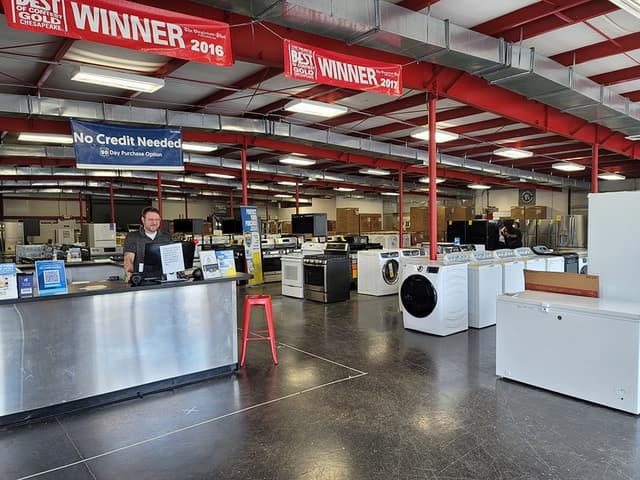
The refrigerator quit somewhere between the Friday grocery run and Saturday breakfast, and by ten in the morning the milk is warm, a borrowed cooler is holding whatever could be saved, and there is a puddle spreading from under the freezer door. The phone is open to a map dotted with retailers running from West Broad Street in Henrico down to Midlothian Turnpike in Chesterfield, and none of the listings agree on anything. One quotes three weeks on a special order, another advertises half-price scratch and dent units with no service department behind them, and a third promises next-day delivery without saying whether the unit sits in a local warehouse or a distribution center two states away. Sorting through appliance stores Richmond VA shoppers can reach inside a thirty-minute drive becomes its own project on an already bad day, and none of those listings answer the thing that decides everything, which is whether a 36-inch French door model can physically clear a 32-inch doorway.
Here is the part that takes the pressure off: every one of those variables is knowable before you spend a dollar. East Coast Appliance has been an employee-owned Virginia company since 1988, with two Richmond-area showrooms on West Broad Street in Henrico and on Midlothian Turnpike near Chesterfield Towne Center, and our team walks local homeowners through this exact decision every week. This guide covers the five types of appliance retailers in the metro and what each one is built for, the ten criteria that genuinely separate them, what happens between checkout and a working appliance, why the service department outweighs the sticker price, how pricing and sale timing actually work, and the fifteen minutes of research worth doing before you drive anywhere.
Get the Right Appliance Delivered, Installed, and Running
Our team matches the model to your actual space, confirms local warehouse stock before you commit, and handles delivery, installation, and haul-away in one trip. Shop online or stop into an East Coast Appliance showroom in the Richmond area.
Explore Appliance Stores Richmond VAKey Takeaways
- Five store types, five business models: Independents, big-box chains, online-only sellers, scratch and dent outlets, and builder supply houses are each optimized for something different. Match the store type to your situation before you compare prices.
- In-stock beats advertised price when something has failed: A unit sitting in a local Richmond warehouse can arrive tomorrow. A special order at fifty dollars less can take three weeks, and no discount covers three weeks without a refrigerator.
- Total cost is not the shelf price: Delivery, installation labor, haul-away, water lines, gas connectors, cords, dryer vent transitions, and stacking kits routinely add 150 to 500 dollars. Ask for one itemized written quote and compare those instead.
- The service department is the real differentiator: A store with in-house technicians and locally stocked parts resolves a warranty claim in days. A hotline referral to a third-party contractor often takes weeks.
The Types of Appliance Stores Richmond VA Shoppers Will Encounter
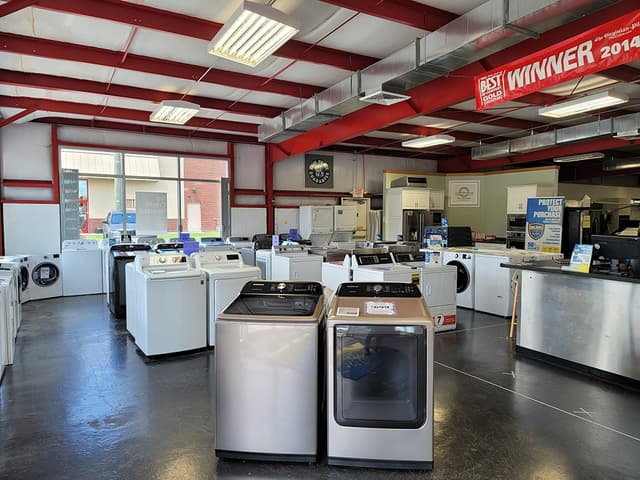
Richmond-area shoppers run into five kinds of appliance sellers: independent and regional appliance specialists, national big-box home improvement and electronics chains, online-only retailers and marketplaces, scratch and dent or used appliance outlets, and builder or trade supply houses. Each one is built around a different business model, and that model decides how much inventory sits nearby, who shows up with the truck, and who answers the phone six months later when the ice maker stops making ice.
Knowing which type you are looking at saves you from comparing two stores that were never trying to do the same job.
What Each Store Type Is Built to Do
- Independent and regional specialists compete on product knowledge, their own delivery crews, deep local stock, and a service department they actually own. Appliances are the entire business, not one aisle of it.
- National big-box chains compete on foot traffic and promotional pricing. Appliances share the building with lumber, paint, or televisions, and delivery and installation are usually contracted out to a logistics provider.
- Online-only retailers and marketplaces compete on catalog breadth. The tradeoff is third-party freight, curbside drop-off, and a return process built around shipping labels rather than a truck coming back.
- Scratch and dent or used outlets compete purely on price. You are buying a cosmetic flaw at a discount, and coverage ranges from a full manufacturer warranty on new-in-box dented units all the way down to as-is with no recourse.
- Builder and trade supply houses are built for volume orders on new construction and multifamily projects. Pricing is structured for contractors, and the selection leans toward builder-grade packages.
Where These Stores Sit on the Richmond Map
Retail here clusters along a few predictable corridors. The West Broad Street run through Henrico into Short Pump and Glen Allen holds the heaviest concentration of showrooms and big-box locations. South of the river, the Midlothian Turnpike and Route 60 corridor near Chesterfield Towne Center serves Midlothian, Bon Air, and the rest of Chesterfield County. Smaller independents and parts shops sit in Lakeside and out toward Mechanicsville and Hanover County, and outlets tend to scatter along secondary roads across the metro rather than in prime retail space.
That geography matters for a practical reason. Delivery routes get built around warehouse locations, so a store with a distribution point in the metro can often reach Ashland, Goochland, and Powhatan on a normal route, while a seller shipping in from outside the region cannot.
Authorized Dealer or Reseller, and Why It Changes Your Warranty
This distinction is the one most comparison articles skip, and it has real money attached. An authorized dealer holds a direct agreement with the manufacturer to sell and, in many cases, service that brand. A reseller buys inventory through secondary channels and sells it without that agreement.
Buying from a non-authorized reseller can affect whether the manufacturer honors the factory warranty, and it usually limits which models you can even get. Brands hold back full lines, premium finishes, and built-in series for authorized partners.
- Ask the store directly which brands it is authorized to sell and which it is authorized to service, since those are two separate agreements.
- Cross-check on the manufacturer website, where GE, Bosch, LG, and most others publish a dealer locator.
- Confirm the full model number on your written quote matches the model number published by the manufacturer.
Brand access varies more than shoppers expect. Nearly everyone can sell GE, Whirlpool, Maytag, Frigidaire, and Samsung. Fewer stores carry GE Profile, Café, KitchenAid, Bosch, LG Studio, Electrolux, and Speed Queen with real depth. Built-in and luxury lines such as Monogram, Sub-Zero, Wolf, and Thermador are restricted to a short list of authorized dealers with trained installers and factory-authorized service, which rules out most online sellers and every outlet.
Read more:
Ten Criteria for Comparing Appliance Stores in Richmond, VA
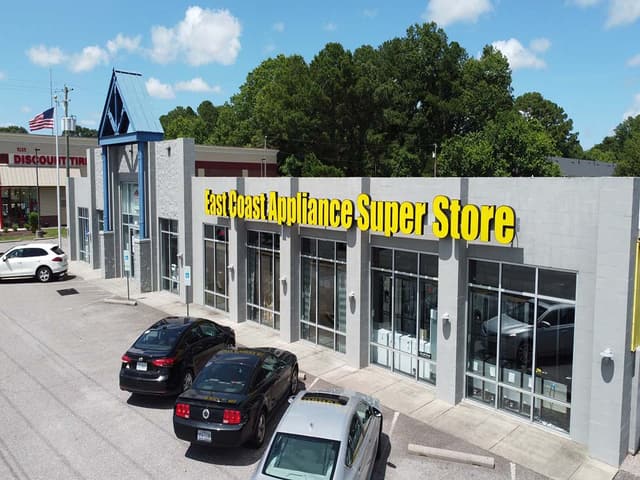
Price is the easiest thing to compare and the least predictive of how the purchase turns out. These ten criteria do a far better job, and you can run any store against them in a single phone call.
- Brand authorization and selection breadth: confirm the store is authorized for the brand you want and carries more than one model line in your category.
- Real in-stock inventory: ask whether the specific unit is in a local warehouse today, not whether it is orderable.
- Salesperson expertise and tenure: a specialist who can name the cutout difference between two counter-depth models is worth more than a discount.
- Written pricing and price match policy: get an itemized quote in writing, including whether the store matches competitors and which sellers are excluded.
- Delivery scheduling and crew type: find out whether the store’s own employees deliver or whether it hands the order to a freight contractor.
- Professional installation scope: clarify exactly what the crew connects, tests, and levels versus what they set in place and leave.
- Haul-away and recycling: verify the old unit leaves with the truck, and whether that is included or an added fee.
- In-house service department with parts: ask whether technicians are employees and whether common parts are stocked locally.
- Warranty and extended coverage terms: understand what the manufacturer covers, what the store adds, and who administers a claim.
- Financing and lease-to-own options: check terms, promotional periods, and whether approval happens before delivery is scheduled.
Why In-Stock Inventory Outranks the Advertised Price
The moment an appliance fails, availability becomes the whole decision. A refrigerator that arrives tomorrow at full price beats one that saves you eighty dollars and lands in nineteen days, because those nineteen days cost far more than eighty dollars in spoiled food, takeout, and ice.
There is a distinction worth insisting on in this market. Floor-model availability is not warehouse stock. A showroom can display twenty refrigerators it does not have in the building, and a website can show a green in-stock badge that reflects national inventory rather than the Richmond warehouse serving Henrico and Chesterfield. Ask the specific question: is this exact model number in the local warehouse today, and can it be loaded on a truck this week.
The Shelf Price Is Rarely the Real Price
Two stores can quote the same 1,299 dollars on the same dishwasher and end up hundreds apart at the door. The gap lives in the add-ons.
- Delivery fee, and whether it changes by zip code or distance
- Installation labor, priced per appliance and sometimes per connection
- Haul-away and disposal of the old unit
- Refrigerator water line kits and shutoff valves
- Gas connector kits and shutoff valves for ranges and dryers
- Dryer vent transitions and periscope ducts for tight closet installs
- Power cords, which most ranges and dryers do not include
- Washer and dryer stacking kits and pedestals
Ask every store for one number that includes all of it. That single request tends to reorder the rankings quickly.
Questions Worth Asking Before You Hand Over a Card
- Is this exact model in the local warehouse, and what is the earliest delivery date.
- Who performs the installation, employees of the store or a subcontractor.
- Is your service department in-house, and which brands are your technicians authorized to service.
- What happens if the appliance does not fit when the crew arrives, and is there a restocking or trip fee.
- Does the price match apply to online-only sellers, and what documentation do you need.
Measuring for Older Richmond Housing Stock
A lot of this metro was built long before anyone designed a 36-inch French door refrigerator. Homes in the Fan, Church Hill, and Northside come with narrow stairwells, doorways framed at 30 or 32 inches, galley kitchens with no turning room, basement laundry down a switchback stair, and radiators that eat into clearance. Condo conversions in Scott’s Addition add freight lift dimensions and loading dock hours to the puzzle.
This is exactly where a store that sends its own crew separates itself. Employees who deliver in these neighborhoods every week know which turns work, when doors have to come off, and when a counter-depth or a 33-inch-wide model is the honest answer instead of the one you wanted. A contracted freight driver paid per stop has no incentive to solve any of that.
Independent, Big-Box, Online-Only, and Outlet Appliance Stores Compared
The table below lines up the four retail types most Richmond shoppers actually choose between. Read the last column first, because the right store depends far more on your situation than on any general ranking.
| Store Type | Typical Pricing | Delivery and Installation | Service and Warranty Support | Best For |
|---|---|---|---|---|
| Independent or Regional Appliance Specialist | Competitive, with price matching on authorized models | Store-employed crews, in-home placement, hookup, and testing | In-house technicians with locally stocked parts | An urgent replacement needing delivery, install, and haul-away in one trip |
| National Big-Box Chain | Promotion-driven around major holiday sale events | Contracted third-party carriers with wide scheduling windows | Manufacturer hotline referral to an outside contractor | A planned remodel package with a flexible timeline |
| Online-Only Retailer or Marketplace | Catalog pricing with variable and sometimes steep freight | Curbside or threshold drop, installation arranged separately | Manufacturer warranty only, claims handled by phone | A hard-to-find model or a niche built-in unit |
| Scratch and Dent or Used Outlet | Deep discounts tied to cosmetic damage | Often customer pickup, limited or no installation | Limited coverage, sometimes strictly as-is | A rental property or garage backup on a tight budget |
For the most common Richmond scenario, an appliance that already failed and needs delivery, installation, and haul-away in a single visit, the independent specialist wins on the one thing that cannot be discounted, which is control over its own trucks, crews, and parts.
Delivery, Installation, and Haul-Away Across the Richmond Metro
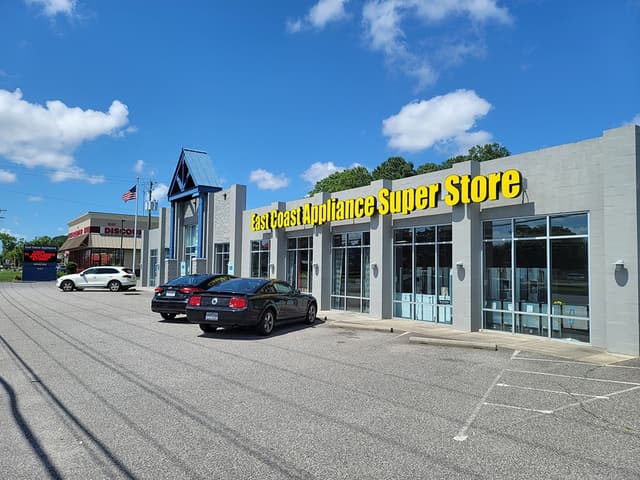
Everything between checkout and a working appliance is where purchases go sideways. Two stores can sell the identical unit and deliver two completely different experiences, and the difference is almost always who employs the person driving the truck.
In-House Crew Versus Contracted Freight
A store-employed delivery crew brings the appliance into the room where it belongs, unboxes it, removes doors if the path demands it, levels the unit, connects it, runs a test cycle, and confirms it works before leaving. If something gets damaged, one company owns the problem.
A contracted freight carrier is paid to move a box from a truck to your threshold. Curbside or garage drop is common, unboxing may not be included, and installation is a separate appointment with a separate vendor. When a scratched door shows up, the store blames the carrier, the carrier blames the manufacturer, and you spend a week on the phone.
Delivery Radius and Scheduling Reality
Same-day and next-day delivery availability depends on local warehouse stock, not on what a website banner says. Routes are built around a distribution point, so Henrico County, Chesterfield County, and Hanover County addresses in Glen Allen, Short Pump, Midlothian, Bon Air, and Mechanicsville usually sit inside the daily route pattern. Ashland, Goochland, and Powhatan often run on set days of the week rather than daily.
Ask two specific things when you schedule. Ask for the delivery window in hours, since a two to four hour window and an all-day window are very different commitments. Then ask whether the crew calls ahead, and how far out.
What Installation Actually Includes, Category by Category
Installation is not one service. Scope changes completely by appliance, and the details below are the ones that turn into surprise charges.
- Refrigerators: leveling, door alignment, water line connection to an existing shutoff valve, and ice maker startup. A saddle valve on old copper line is frequently refused and replaced.
- Dishwashers: supply line, drain line, disposal knockout plug removal, air gap or high loop, electrical connection, and leak testing under the door.
- Over-the-range microwaves: mounting plate into studs, cabinet-top venting, and configuration for recirculating, vertical, or horizontal exhaust.
- Gas ranges: flexible connector, shutoff valve, leak test, and the anti-tip bracket the manufacturer requires.
- Electric ranges and cooktops: correct 240-volt receptacle, matching three-prong or four-prong cord, and anti-tip hardware.
- Washers: hot and cold supply hoses, standpipe or drain box fit, and leveling to control vibration on second-floor laundry.
- Dryers: 240-volt cord or gas connector, plus a vent run that meets length and elbow limits. Long or crushed vent runs are the top cause of poor drying performance.
Here is the detail our delivery crews plan around every single week: measure the doorway at the casing with the door open, not at the framed opening, because the door slab and hinges typically steal about one and a half inches, and a 32-inch doorway is often a 30-inch doorway in practice. That inch and a half is the difference between a refrigerator that rolls in and a refrigerator that goes back on the truck.
Haul-Away and Recycling of the Old Unit
Refrigerators, freezers, and air conditioners contain refrigerant that has to be recovered by trained handlers rather than dumped at a transfer station. Responsible haul-away means the old unit goes to a recycler that reclaims refrigerant, oil, and metal properly.
Independents commonly bundle haul-away with delivery. Chains and online sellers more often treat it as a per-item upcharge, and some carriers refuse it entirely, which leaves a dead refrigerator on your carport until you arrange a separate pickup.
The Prep That Is On You
The crew controls the truck. You control the room, and five minutes of prep prevents most failed deliveries.
- Measure the appliance and every doorway, hallway turn, and stair landing along the path.
- Clear the route completely, including rugs, storm doors, and anything on the landing.
- For condos downtown or in Scott’s Addition, confirm freight lift dimensions, loading dock access, and any window of time the building allows moves.
- Check cabinet cutout width, height, and depth, and account for countertop overhang on a slide-in range.
- Verify the existing water shutoff, gas shutoff, and outlet are current and reachable.
- Confirm the doors on the new unit can swing fully open once it is in position.
One more thing to settle in advance. Some work legally belongs to a licensed plumber or electrician, including running a new gas line, adding a dedicated circuit, or converting a receptacle. Ask the store exactly what its crew is permitted to do so that nothing stalls on delivery day.
Why the Service Department Matters More Than the Sticker Price
Appliances break. Compressors fail, control boards go out, and door seals give up. What separates a good purchase from a bad one is what happens on that day, which is decided by where you bought it.
Three Different Things People Call the Warranty
The manufacturer warranty is coverage from the brand, usually one year on parts and labor, with longer terms on sealed systems and some motors. The claim belongs to the manufacturer, and the brand decides who repairs it.
A store-backed extended protection plan is a separate contract that picks up after the factory term. Read who administers it, since some are handled by the retailer and others by a third-party underwriter with its own contractor network.
The store’s own service department is different from both. It is a team of technicians on payroll. When the store sells the appliance, holds the factory authorization, and employs the technician, one phone call starts the repair instead of three.
Realistic Timelines
When a retailer owns the repair, an in-warranty service call in the Richmond area typically gets scheduled within a few business days, and common parts such as igniters, water valves, and door gaskets often sit on the shelf locally. When the claim routes through a manufacturer hotline to an independent contractor, the sequence stretches to a diagnostic visit, a parts order, and a second visit, which is how a two-day repair becomes a three-week repair.
Parts depth matters most on premium and built-in equipment. Sealed system work on refrigeration and control board replacement on high-end ranges require factory-authorized training, and using an unauthorized technician can void coverage on the exact repair you most want covered.
Questions That Separate Real Service From Marketing Language
- Are your technicians employees of the store or subcontractors.
- Which brands are your technicians factory authorized to service.
- Are common parts stocked locally, or ordered per job.
- What is your typical response window for an in-warranty call.
- Do you service appliances after the manufacturer warranty expires, and do you service units you did not sell.
When Repair Beats Replacement
A reasonable rule for appliance repair in Richmond: if the unit is less than half its expected service life and the repair costs less than half the price of a comparable new one, fix it. Refrigerators typically run 10 to 13 years, ranges 13 to 15, dishwashers 9 to 12, and washers and dryers 10 to 13.
Cost of the specific part matters too. An igniter, a thermostat, or a drain pump is routine. A compressor or a control board on a nine-year-old unit is usually money spent on borrowed time.
What You Give Up Buying Online or As-Is
Buy from an online-only seller and you still hold the manufacturer warranty, but the service relationship disappears. You call the brand, the brand assigns a local contractor with no connection to your purchase, and every scheduling problem becomes yours to manage.
An as-is outlet purchase shifts even more risk. Some outlet units are new-in-box with dents and carry a full manufacturer warranty, which is a genuinely good deal. Others are sold with no coverage at all, and the only way to know which one you are buying is to get the answer in writing on the invoice.
Appliance Stores Richmond VA: Advantages and Disadvantages of Buying Local
Buying from a local independent is a trade-off, not a moral position. The honest answer depends on how urgently you need the appliance, how tight the budget is, and how complicated the installation looks.
Pros
Specialists who know the models
Salespeople who work only in appliances can tell you which counter-depth model fits a 69-inch opening and which range needs a deeper cabinet cutout. That knowledge prevents the most expensive mistake, which is buying something that does not fit.
Crews who work for the store
In-home placement, leveling, hookup, and testing come from employees, and accountability stays in one place if something is damaged.
A local service department and parts inventory
In-house technicians and locally stocked parts turn a warranty claim into a scheduled visit rather than a phone tree.
Faster access to warehouse stock
Regional independents carry deep local inventory precisely because urgent replacements are their core business, which is what makes next-day delivery realistic.
Price matching closes the gap
Buying group leverage lets independents match national chain pricing on identical model numbers, so choosing local rarely costs more.
Cons
Smaller showroom floors
An independent showroom holds fewer total units on display than a national chain warehouse store, so some models have to be seen through the catalog and spec sheets.
Less instant self-service online
National e-commerce sites offer around-the-clock browsing and one-click checkout, while a local store’s best answers usually come from a conversation during business hours.
Read more:
Pricing, Price Matching, Financing, and the Best Time to Buy Appliances
Appliance pricing confuses people because it does not work like most retail. Understanding the mechanics behind the number saves more than any coupon.
Why Identical Models Cost Nearly the Same Everywhere
Manufacturers set a minimum advertised price, and authorized dealers who advertise below it risk losing the brand. Independents also join national buying groups that pool purchasing volume, which is what lets a regional store buy at pricing comparable to a national chain.
The practical result is that the same full model number often lands within a few dollars across authorized dealers, and the real differences show up in delivery, installation, haul-away, and service.
Derivative Model Numbers Make Comparison Harder
Chains frequently sell derivative models, which are versions of a base unit built with a slightly different feature set and a unique model number for that retailer. It looks like the same refrigerator with a better price, and sometimes it is missing a shelf material, an ice maker feature, or a compressor warranty term.
Compare full model numbers, not marketing names or capacity headlines. If two model numbers differ by even one character, pull both spec sheets before deciding anything.
Do Appliance Stores Price Match
Most authorized dealers, including East Coast Appliance, will match a legitimate advertised price on the identical model number. What stores usually require:
- A current advertisement, screenshot, or written quote showing the price and the full model number
- An authorized dealer as the competing seller, with the item in stock
- The comparison to include delivery and installation terms rather than the unit price alone
Typical exclusions include marketplace third-party sellers, auction listings, open-box and clearance units, member-only pricing, and pricing errors. Ask before you shop rather than at the register.
The Appliance Sales Calendar
Timing genuinely moves the number. The heaviest promotional periods are Presidents Day, Memorial Day, the Fourth of July, Labor Day, and Black Friday through Cyber Monday.
Two quieter windows are worth knowing. Manufacturers roll out new model years in late summer and early fall, so September and October bring discounts on outgoing models that are functionally identical to the new ones. End-of-month and end-of-quarter clearance can also move floor models and overstock, especially on units taking up warehouse space.
None of that helps when a refrigerator dies in July. Buy on the calendar when you are planning, and buy on availability when you are replacing.
Packages, Bundles, and Laundry Pairs
Kitchen appliance packages usually beat piecemeal buying when you need three or more units at once, since manufacturers fund package rebates that scale with the number of pieces. Matching finishes and handle designs across a suite is easier in a package too, which matters more than people expect in an open-plan Short Pump or Midlothian kitchen.
Piecing units together makes more sense when you only need one or two appliances, when you want the best model in one category rather than a consistent set, or when a single unit is available now and the package requires a wait.
Financing, Protection Plans, and Scratch and Dent
Promotional financing with a twelve-month no-interest period works well if you can clear the balance inside the term, since deferred interest can be charged retroactively if you do not. Lease-to-own programs approve more shoppers but cost substantially more over the full term, so read the total-of-payments figure rather than the weekly number.
Scratch and dent appliances fit two shoppers especially well: rental property owners and anyone installing a unit where a side panel will never be seen. Cosmetic damage usually does not affect the manufacturer warranty on new-in-box units, but the invoice needs to state the coverage explicitly.
Energy Costs and Virginia Rebates
Purchase price is one year of the decision, and operating cost is the next ten. An ENERGY STAR certified refrigerator or clothes washer can save 25 to 50 dollars a year against an older non-certified unit, which adds up over a decade of ownership.
Ask about current utility rebates before you buy, since Dominion Energy and several Virginia co-ops periodically offer rebates on qualifying efficient appliances and recycling incentives for old working refrigerators. Programs change annually, so confirm what is active in your service territory at the time of purchase.
Do This Before You Drive to a Richmond Appliance Showroom
Fifteen minutes of research eliminates most of the stores on your list and saves an entire Saturday. Work through it in this order.
Read the Google Business Profile Properly
Star rating alone tells you very little. Look at review volume, how recent the newest reviews are, and whether the owner responds to complaints with specifics or with a copy-pasted apology. Read the three-star reviews, which are usually the most honest.
Then look for patterns instead of outliers. One angry post about a delivery window means nothing. Fifteen posts about damaged units and unreturned calls over four months means something.
Verify the Practical Details
- A verified street address you can find on a map, not a mailbox
- Current hours, including whether holiday hours are updated
- A local phone number that a person at the store answers
- Real photos of the actual showroom and warehouse, not stock product images
- Listed service categories such as delivery, installation, repair, and parts
Be skeptical of a listing with no photos, no physical address, or a call center number that routes somewhere else. Cross-check the same business on Yelp and the Better Business Bureau, and pay attention to how complaints were resolved rather than to how many exist.
What the Website Should Show
- Live inventory or an in-stock indicator tied to local warehouse availability
- A delivery zip code checker or a clearly published delivery area
- Brand pages showing which lines the store is authorized to sell
- Published delivery, installation, and haul-away policies with pricing
- Financing terms spelled out, including promotional periods
- A real service and parts page with a phone number and hours
The Showroom Visit Checklist
Bring the following and the visit takes twenty minutes instead of two trips.
- Cutout width, height, and depth measurements, plus the doorway and path measurements.
- Photos of the space, the doorway path, and any stairs or turns.
- The model number of the existing appliance.
- Photos of the water shutoff, gas shutoff, outlet, and dryer vent.
- A note on whether your laundry is on a second floor, in a closet, or in a basement.
Ask to see units powered on. Open the doors, pull the racks, run a range burner, and listen to a dishwasher cycle if one is running. Spec sheets do not tell you that a crisper drawer binds or that a handle sits where a cabinet corner is.
The Red Flags That Matter Most
- Pressure to buy a floor model as-is without written warranty terms
- Vague delivery windows with no committed date
- A verbal quote with no itemized written breakdown of fees
- Refusal to name who performs the installation
- No answer on whether service is in-house or referred out
- A model number that does not appear on the manufacturer website
How East Coast Appliance Measures Up
Run that checklist against East Coast Appliance and the answers are specific. Two Richmond-area showrooms, one on West Broad Street in Henrico and one on Midlothian Turnpike near Chesterfield Towne Center, both with real inventory you can see running. Employee-owned and Virginia-based since 1988, which is why the person helping you has a stake in how the delivery goes. Same-day and next-day delivery in select markets driven by local warehouse stock, professional installation, haul-away of the old unit, in-house parts and service, a best price guarantee, and financing options handled before delivery is scheduled.
The Downtime Math Most Appliance Shoppers Skip
Every comparison guide talks about price and nobody puts a number on waiting, which is strange, because waiting is usually the largest cost in an urgent replacement. Downtime has a real daily rate, and once you calculate it, a three-week special order that saves a hundred dollars stops looking like a deal. Work out your own number before you choose between a store with the unit in a local warehouse and a store that has to order it, then compare that figure against the price difference. For most Richmond households the daily cost of a dead refrigerator or a dead washer lands somewhere between 20 and 60 dollars, which means a two-week wait quietly costs more than almost any discount on the shelf.
- Spoiled food in a failed refrigerator: 300 to 600 dollars for a full family fridge and freezer, incurred once, on day one.
- Ice and cooler workarounds: roughly 10 to 15 dollars a day to keep essentials cold while you wait.
- Restaurant and takeout premium: 25 to 50 dollars a day for a family cooking less because the range or refrigerator is out.
- Laundromat cost for a dead washer: 20 to 35 dollars per trip for a family of four, plus two hours of your time.
- Water damage risk from a leaking washer or dishwasher left in place: unpredictable, and the reason a same-week replacement beats a discount.
- Second time off work: half a day of pay if a curbside delivery forces you to schedule a separate installer visit.
- Restocking or return trip fees when a unit does not fit: commonly 100 to 200 dollars, avoidable with one measurement.
Read more:
- Richmond's Most Popular Refrigerator Models [With Real Customer Reviews]
- Top-Rated Appliance Store in Chesapeake, VA: East Coast Appliance
Compare Appliance Stores Richmond VA, Then Shop East Coast Appliance Today
Choosing well comes down to three moves. Identify which store type fits your situation, weigh delivery, installation, haul-away, and service alongside the price tag, and confirm both fit and local availability before you buy anything. Do those three and the appliance shows up on time, fits the first try, and has someone local standing behind it.
Ready to shorten the list? Shop East Coast Appliance online, or visit our West Broad Street showroom in Henrico or our Midlothian Turnpike showroom near Chesterfield Towne Center, and check availability before you drive out. As an employee-owned Virginia independent, we put specialists in front of you who know cutout dimensions and model differences cold, we match competitor pricing on identical models so there is no reason to chase a chain, our delivery crews and installers work for us rather than a freight contractor, we haul away the old unit on the same trip, and our service department is here in Virginia when you need it after the sale. That is the part a big-box handoff cannot give you.
Frequently Asked Questions about Appliance Stores Richmond VA
The best appliance store for delivery and installation in Richmond is one that employs its own delivery crews and installers rather than contracting the work to a freight carrier, which is how East Coast Appliance handles both from its West Broad Street and Midlothian Turnpike showrooms. Store-employed crews place the unit in the room, connect and test it, and take the old appliance with them, so accountability stays with one company.
On identical model numbers, local independent stores and big-box chains usually price within a few dollars of each other because manufacturers set minimum advertised pricing and independents buy through national buying groups. The real cost difference shows up in delivery fees, installation labor, haul-away charges, and parts kits, which is why an itemized written quote is the only fair comparison.
Most authorized dealers in the Richmond area do price match advertised pricing from other authorized online sellers on the identical full model number, provided the item is in stock and you show a current ad or written quote. Marketplace third-party listings, auction sites, open-box units, and member-only pricing are typically excluded from those policies.
Delivery in the Richmond metro runs from same-day or next-day for units sitting in a local warehouse to two or three weeks for special orders shipped from a manufacturer. Addresses in Henrico, Chesterfield, and Hanover counties generally fall inside daily delivery routes, while Goochland, Powhatan, and Ashland are often served on set days.
Many appliance stores do haul away the old unit at delivery, and independents commonly bundle it with the purchase while chains and online sellers often charge a per-item fee. Refrigerators, freezers, and air conditioners contain refrigerant that must be recovered by trained handlers, so proper recycling matters more with those units than with a range or a dishwasher.
The strongest promotional periods for appliances in Virginia are Presidents Day, Memorial Day, the Fourth of July, Labor Day, and Black Friday weekend, along with September and October when new model years arrive and outgoing inventory is discounted. Those windows only help when you are planning ahead, since an appliance that has already failed should be bought on local availability instead.
Why Trust East Coast Appliance?
Locally owned and operated since 1988, East Coast Appliance is the largest independent appliance dealer in Virginia. We sell it ALL — from new name-brand appliances to scratch-and-dent appliances to our very own refurbished appliances. Aside from our huge selection of every major brand and everyday low prices, what sets us apart from our competitors is that we service what we sell and that we are locally owned and operated with factory-trained associates. And if you’re a local, great news: East Coast Appliance is committed to providing the absolute lowest prices on the same available brand and model — simply bring in the ad of the local retail competitor while the lower price is in effect, and you'll receive your price match.
Shop Appliances at East Coast
There is a reason we are dubbed “The Discount King” — for unbeatable deals, shop refrigerators online at East Coast Appliance. Our friendly associates are always happy to help you find the best column refrigerator for your home, whether you call us or use our online chat feature. Better yet, stop by one of our showrooms to see why we are the best appliance store in Virginia. Visit us today!